
An inference pod that starts for the first time downloads its model from the internet. A 70-billion-parameter model is well over a hundred gigabytes. Start twenty pods and you download it twenty times, from a public site, through your firewall, onto GPU nodes that bill by the hour while they wait. In an air-gapped network it does not work at all. MatrixHub is a self-hosted model registry that speaks the Hugging Face protocol. You point your inference servers at it with one environment variable, it fetches a model from Hugging Face once, stores it, and serves every later request from inside your network. The CNCF Landscape lists it under AI Native Infra › Model Asset and Registry, as a Sandbox project, accepted on 28 September 2026.
CNCF daily · Sprint 6, post 14 of 26 · AI Native Infra (Model Asset and Registry) · CNCF Sandbox
At a glance
| Category | AI Native Infra › Model Asset and Registry |
| CNCF status | Sandbox; the Landscape records acceptance on 2026-09-28 |
| Repository | github.com/matrixhub-ai/matrixhub |
| Written in | Go (per the project’s generated architecture notes) |
| What it is | A Hugging Face-compatible model hub for private, enterprise use |
| Built for | vLLM and SGLang; its docs and roadmap also mention llm-d and Dynamo |
| Storage | Local filesystem, NFS and S3-compatible backends |
| Install | Docker Compose for one host; Helm chart (OCI) for Kubernetes |
| Maturity | Early: a Helm chart version of 0.1.1 appears in a third-party guide, and the roadmap says it “describes direction, not commitments” |
| Live demo | The project hosts one for evaluation; it may be reset at any time |
A note on the name: other, unrelated projects are also called Matrix Hub (one is a catalogue for AI agents and MCP servers). This post is only about the model registry from the matrixhub-ai organisation.
The problem MatrixHub solves
| Question | Pulling from Hugging Face directly | With MatrixHub |
|---|---|---|
| Twenty pods start | Twenty downloads from the internet | One download, then twenty local pulls |
| Air-gapped site | Not possible | Controlled import and export of approved models |
| Who may use which model | Whoever has a token | Projects, roles, access keys and robot accounts |
| Same model in two regions | Download twice, or copy by hand | Policy-driven replication between sites |
| Changing code | None | None: set HF_ENDPOINT |
| Consistency | A repository can change under you | Tags can be locked, so production keeps a fixed version |
Key concepts
| Term | Meaning |
|---|---|
| Hugging Face compatibility | MatrixHub answers the same API as the Hub, so hf and inference servers work when HF_ENDPOINT points at it |
| Proxy cache | On a miss it fetches from Hugging Face and keeps the files; later requests are served locally |
| Project | A namespace for model repositories, with visibility settings |
| Repository and tag | A model and its versions; tags can be locked |
| Robot account | A non-human identity for pipelines and pods |
| Replication | Pull or push sync between MatrixHub instances, manual or scheduled, with chunked and resumable transfer |
| Git access | Clone, pull, tag and push over HTTP or SSH |
| Air-gapped transfer | Export approved models, carry them across, import them on the other side |
Architecture
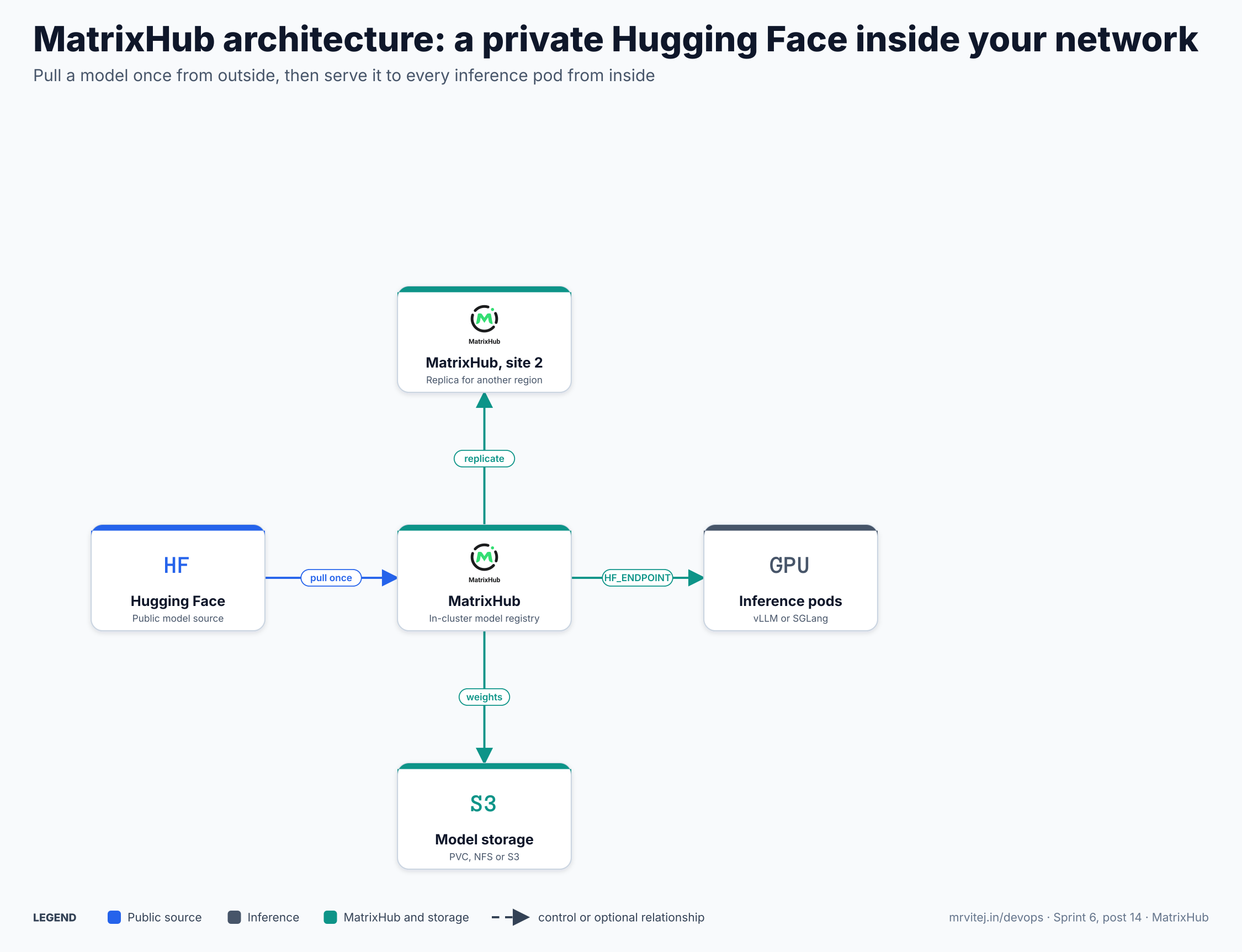
Blue is the public source, grey is inference and teal is MatrixHub and its storage. Open the zoomable diagram, or download it as SVG or PNG.
| Component | Responsibility |
|---|---|
| Hugging Face | The public source of open models; only MatrixHub talks to it. |
| MatrixHub | Serves the Hugging Face API, caches, manages projects, users and tags, and runs replication jobs. |
| Model storage | Holds the weights: a persistent volume, NFS or an S3-compatible store. For file-system storage ideas see the CubeFS brief. |
| Inference pods | vLLM or SGLang servers that read models through HF_ENDPOINT. |
| Second MatrixHub | A replica in another region or site. |
| Database | The Helm chart includes a built-in MySQL for metadata, and the chart notes say external databases can be configured. |
The first pull fills the cache
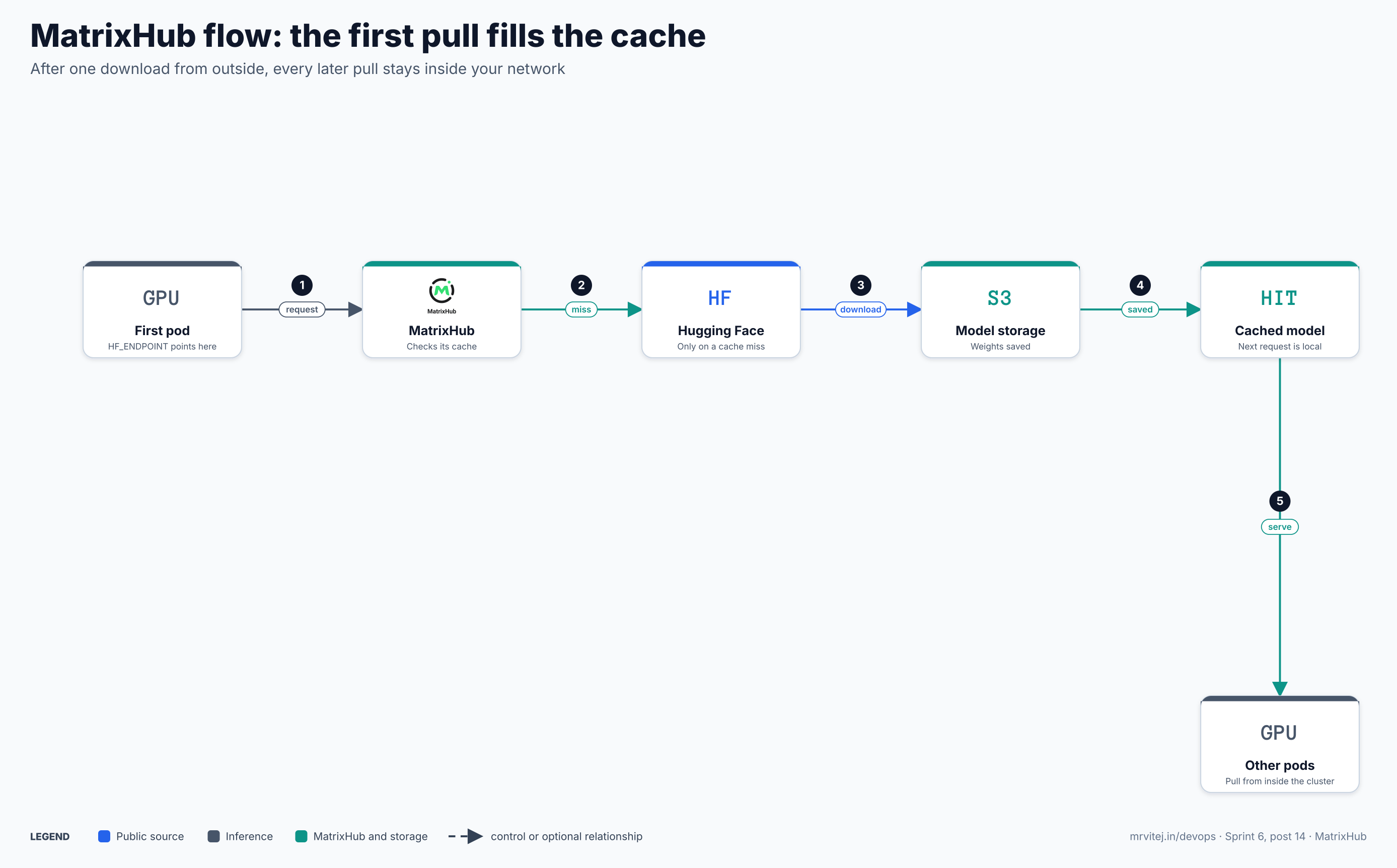
- Request. The first pod asks MatrixHub for the model.
- Miss. MatrixHub finds nothing in its cache.
- Download. It fetches the files from Hugging Face.
- Saved. The weights are written to model storage.
- Serve. Every later pod pulls from MatrixHub, inside the cluster.
Open the zoomable flow diagram, or download it as SVG or PNG.
Real world: scaling a model from 2 pods to 20
The ERP copilot runs a mid-size open model on spot GPU nodes. On a quiet night there are two pods; at month-end close the autoscaler adds eighteen more. Without a local cache, each new node downloads the weights from the internet before vLLM can load them, so the extra capacity arrives after the rush. NVIDIA’s Dynamo documentation shows the effect for one small model in one environment: about 10 seconds to fetch a pre-cached model from MatrixHub against about 6 minutes from public Hugging Face, and the same page says this is one measurement, not a general benchmark. A large model on your own network will behave differently, so measure it. The design point holds anyway: pre-cache the approved model, and new nodes read it from inside the cluster.
Install MatrixHub
These steps follow the MatrixHub README and the third-party guides I found. I did not run them for this post.
One host, with Docker
docker run -d -p 9527:9527 -v $PWD/data:/data ghcr.io/matrixhub-ai/matrixhub:main
# console on http://localhost:9527
The project also ships a Docker Compose file and config, with the console on port 3001 (changeable with MATRIXHUB_HTTP_PORT). The README and the install docs use different ports for the two methods, so use the one that matches the method you chose. Use a pinned image tag instead of main for anything beyond a trial.
On Kubernetes, with Helm
Requirements named in a third-party guide: Kubernetes 1.19 or newer, Helm 3.8 or newer, and a default StorageClass.
export CHART_VERSION=<chart-version>      # the guide used 0.1.1; check the releases page
export NAMESPACE=matrixhub

helm install matrixhub oci://ghcr.io/matrixhub-ai/matrixhub \
  --version "$CHART_VERSION" \
  --namespace "$NAMESPACE" --create-namespace \
  --set apiserver.service.type=NodePort

kubectl -n "$NAMESPACE" get deploy,statefulset,pods,pvc,svc
Values called out in that guide, with defaults: apiserver.service.type (ClusterIP), apiserver.storage.pvc.size (50Gi, the model files) and mysql.persistence.size (8Gi, the built-in database). Model weights are large, so raise the first one. Use helm show values for the real names in your version, because key names can change.
Then cache a model and point an inference server at it:
# from a host that can reach MatrixHub (example endpoint)
HF_ENDPOINT="http://matrixhub.example.com:30001" hf download Qwen/Qwen3-0.6B
# in the vLLM container spec
env:
- name: HF_ENDPOINT
value: http://matrixhub.matrixhub.svc.cluster.local:<service-port> # confirm the port with kubectl get svcNVIDIA’s Dynamo guide uses the same pattern: HF_ENDPOINT on both the frontend and worker, with the model pre-cached and the repository layout compatible with Hugging Face requests.
Try it
- Install with the Docker command above on a laptop, or use the project’s hosted demo for a first look (do not upload anything private there).
- Run
HF_ENDPOINT=http://localhost:9527 hf download <small-model>and watch it fetch and store the files. - Run the same command again and confirm it returns fast and does not go to the internet (check your network or the MatrixHub logs).
- Start a small vLLM or SGLang container with the same
HF_ENDPOINTand load the model from MatrixHub.
Production reference design
- Run it in its own namespace with a dedicated storage class, sized for your model set, not for a demo.
- Use an external database and existing PVCs when you need data to survive reinstalls. The third-party guide warns that
helm uninstallremoves the default PVCs the chart created. - Put it behind your gateway with TLS and your identity provider rules; do not leave a NodePort open.
- Pre-cache approved models in a pipeline step, so no pod triggers a first download in production.
- Lock tags for production models, so a repository change upstream cannot change what you serve.
- Use robot accounts for pods and pipelines, with read-only roles.
- Replicate to each region that runs GPUs, on a schedule outside peak hours.
- Plan the air-gap path if you need it: export, scan, carry across, import.
- Back up the metadata database and the storage backend, and test a restore.
- Monitor disk use, request errors, replication lag and cache hit rate.
Security
- Model files are code-adjacent. Some formats can run code when loaded; scan and review models before approving them, and prefer safe tensor formats.
- Integrity. The project lists malware scanning and content signing as features; verify what your version actually ships before relying on them.
- Access. Use projects, roles and robot accounts; give pods read-only access to approved projects.
- Change default credentials. The demo uses public credentials, and any default admin account in your own install must be changed first.
- Network. Only MatrixHub should reach Hugging Face. Inference pods should reach MatrixHub and nothing outside.
- TLS. Terminate TLS in front of it; model weights and tokens should not cross the network in clear text.
- Licences. A model’s licence still applies when you mirror it; record which models you hold and why.
Troubleshooting
This table is based on the MatrixHub README and the third-party Helm guide. I did not run MatrixHub for this post, so test each entry on your own cluster.
| Symptom | Likely cause | How to check | Fix |
|---|---|---|---|
helm install cannot pull the chart |
Helm older than 3.8, or no access to ghcr.io | helm version; try helm show chart oci://ghcr.io/matrixhub-ai/matrixhub |
Upgrade Helm, or mirror the chart internally |
| Pods or PVCs stay Pending | No default StorageClass | kubectl describe pvc |
Set a StorageClass or existing PVCs |
| ImagePullBackOff | Nodes cannot reach the image registry | Pod events | Mirror the images or open egress |
| App waits for the database | Built-in MySQL not ready, or wrong external DB settings | StatefulSet and pod logs | Fix the database settings, wait for Ready |
| Port 30001 not reachable | Service is still ClusterIP, wrong node IP or firewall | kubectl get svc |
Set the NodePort type or use kubectl port-forward |
| Compose port 3001 in use | Another process has the port | ss -ltnp |
Set MATRIXHUB_HTTP_PORT |
| First download is slow or fails | Upstream fetch through the proxy | MatrixHub logs and egress rules | Allow egress to Hugging Face from MatrixHub only |
| vLLM cannot find the model | Model not in MatrixHub, or layout not Hugging Face-compatible | hf download against MatrixHub by hand |
Pre-cache the model, check the repository name |
| Login or download denied | Credentials or project role | Account and project roles | Use a robot account with read access |
| Data gone after reinstall | helm uninstall removed the default PVCs |
kubectl get pvc before uninstall |
Use existing PVCs and an external database |
| Port mismatch between docs | Docker (9527) and Compose (3001) differ | The method you used | Use the port for your install method |
Usage cases
- Faster inference start-up. Pull once, serve many pods.
- Air-gapped clusters. Import approved models into an isolated network.
- Governed model catalogue. Projects, roles and locked tags for production models.
- Multi-region GPU sites. Replicate models to each site.
- In the Sprint 6 project. The ERP’s GPU nodes read the copilot’s model from MatrixHub, and the vLLM post that follows serves it from there.
Operational considerations
- It is young. The roadmap lists most advanced items as direction, not delivered features; check the releases and open issues before committing to a feature.
- Storage is the cost. Every model version you keep takes space; set a retention rule.
- Cache policy. Decide which models may be fetched automatically and which must be imported by a person.
- Version compatibility. Hugging Face client behaviour changes; pin the client and MatrixHub versions together and test upgrades.
- Single point of failure. If pods cannot start without it, run it highly available, or keep a fallback path for critical models.
- Planned items. Roadmap items such as peer-to-peer pre-warming through Dragonfly and Run:ai Model Streamer support are not marked as delivered.
Adoption
The Landscape lists MatrixHub as a Sandbox project accepted on 28 September 2026, and NVIDIA’s Dynamo documentation has a page on loading models from it. I did not find a verified list of named production users, so none are named.
Alternatives
| Solution | Model | Best suited to |
|---|---|---|
| Kubeflow Model Registry | Metadata registry for models, listed in the same Landscape subcategory | Teams that want model metadata and versions inside Kubeflow |
| Harbor | OCI registry that can store models as artifacts | Teams that already run Harbor and package models as OCI images |
| Hugging Face Enterprise Hub | Hosted, with enterprise controls | Teams that prefer a managed service |
| JFrog Artifactory or Nexus | General artifact repositories | Teams that already manage all artifacts there |
| MLflow Model Registry | Experiment tracking with a registry | Teams whose workflow centres on MLflow |
| A plain S3 bucket plus an init container | Copy weights at start-up | Small setups where a simple copy is enough |
Strengths and limitations
| Strengths | Limitations |
|---|---|
| Drop-in Hugging Face API, no code change | Early project; Sandbox status and a young chart |
| Pull once, serve many | You own storage, backups and availability |
| Projects, roles, tags and robot accounts | Some listed features may not be delivered yet |
| Replication and air-gap workflows | Install docs and ports differ between methods |
| Works with vLLM and SGLang, and documented with Dynamo | Few public production references |
| Helm chart and Docker options | Does not replace model scanning or licence review |
Recommendation
Pilot it where model download time or air-gapping hurts. Install it in a non-production namespace with S3-compatible or NFS storage, pre-cache one approved model, point a vLLM deployment at it with HF_ENDPOINT, and measure start-up against a direct download on your own network. Plan storage, backups and an external database before production, and read the release notes for the features you need, because the roadmap items are not commitments. If you already run Harbor or Artifactory and your inference servers can pull from an OCI image or a mounted volume, that may be enough without a new component.
References: MatrixHub repository · MatrixHub README · MatrixHub roadmap · MatrixHub architecture notes (DeepWiki) · Self-host MatrixHub with Helm (third-party guide) · NVIDIA Dynamo: load models from MatrixHub · CNCF Landscape entry