Sprint 3 covered 21 categories and 21 tools, and one of them, OpenEBS, came with its backup companion K8up. This post connects them into one platform that can be built, operated and broken on purpose. The theme is the edge: a retail chain runs the same shop application in a cloud cluster and in a store’s back room, and the store keeps selling when the link to the cloud is down. A customer places an order, the order is priced by a Java service, an event goes to Kafka, and an inventory service reserves stock in TiKV. Karmada places the workloads, Submariner and KubeEdge connect the sites, k8gb and MetalLB decide where traffic lands, and Kuma, Keycloak and Pinniped decide who may talk to what. The business logic is deliberately trivial; the value is in how the tools meet.
The cloud side runs on Google Cloud in Mumbai (asia-south1) on Compute Engine VMs with self-managed Kubernetes and Calico, not GKE. That was a decision made at the start of the sprint: Submariner’s tested network plugins include Calico but not GKE’s native one, so every tool here runs on a path its own project documents. The edge site is a small bare-metal cluster. Steps that are specific to Google Cloud are labelled GCP.
Four honest notes before the table, because several tools overlap and each needs a clear job:
- Two ways to reach the edge. Karmada places workloads on whole clusters. KubeEdge attaches single machines and devices (kiosks, shelf sensors) as nodes of the cloud cluster. They solve different problems and are not alternatives here.
- Two ways to cross sites. Submariner gives pod-to-pod and DNS connectivity between the clusters for things like database replication and
clusterset.localnames. Kuma’s multi-zone mesh carries application traffic with mutual TLS. Keep the CIDR ranges apart and give each a different job. - Two RPC styles. Dapr provides the event and invocation APIs for the Go services. Dubbo is used for one thing, the Java pricing service, whose Triple protocol is also callable with plain gRPC.
- Two identity jobs. Keycloak is the identity provider for customers and staff. Pinniped uses Keycloak to log engineers in to every cluster with
kubectl. TiKV has no Dapr component in this design, so the inventory service uses TiKV’s client library directly.
The platform at a glance
| Layer | Tool | Role in the platform | Brief |
|---|---|---|---|
| Application | Dapr | Pub/sub and service invocation APIs through a sidecar for the Go services | Dapr |
| RPC | Apache Dubbo | Java pricing service over the Triple protocol, with Nacos as its registry (not a CNCF project) | Apache Dubbo |
| Streaming | Apicurio Registry | Schema rules for events on the Kafka orders topic |
Apicurio Registry |
| Database | TiKV | Transactional stock ledger with three replicas | TiKV |
| Storage | OpenEBS and K8up | Volumes for TiKV and Kafka; restic backups of volumes to Cloud Storage | OpenEBS and K8up |
| Orchestration | Karmada | Places and overrides workloads across the cloud and edge clusters | Karmada |
| Delivery | OpenKruise | CloneSets with in-place updates and image pre-pulls | OpenKruise |
| Service mesh | Kuma | Multi-zone mesh with mutual TLS and traffic permissions | Kuma |
| API gateway | Higress | Public entry at each site: routing, JWT checks, rate limits | Higress |
| Global routing | k8gb | DNS-based failover between the cloud and the edge | k8gb |
| Service proxy | MetalLB | Gives the bare-metal edge a load-balancer address | MetalLB |
| Cloud network | Submariner | Encrypted tunnel and cross-cluster service discovery | Submariner |
| Runtime | WasmEdge | Wasm node pool at the edge for small promo-rule modules | WasmEdge |
| Security | Keycloak | Single sign-on and tokens for customers and staff | Keycloak |
| Registry | zot | Central registry in the cloud and a caching registry at each edge | zot |
| Automation | KubeEdge | Connects kiosks and sensors as edge nodes that keep working offline | KubeEdge |
| Key management | Pinniped | One kubectl login to every cluster through Keycloak (not a CNCF project) |
Pinniped |
| Observability | Fluentd | Per-node log collection with file buffering and forwarding | Fluentd |
| Chaos engineering | ChaosBlade | Fault experiments on nodes, pods and the link between sites | ChaosBlade |
| Optimization | Kruize | Right-sizing recommendations from Prometheus history (not a CNCF project) | Kruize |
| Feature flagging | GO Feature Flag | Flags as a file in Git, served by a relay proxy through OpenFeature (not a CNCF project) | GO Feature Flag |
Supporting pieces that are not Sprint 3 tools: Kubernetes with kubeadm and Calico, containerd, Kafka (from Strimzi in Sprint 2), PostgreSQL (from CloudNativePG) for Keycloak and Apicurio, Nacos for Dubbo, OpenSearch for log search, Prometheus and Grafana, cert-manager, Cloud DNS, Cloud Load Balancing, Cloud Storage and Terraform. They are inexpensive to replace and are named wherever they appear.
Architecture
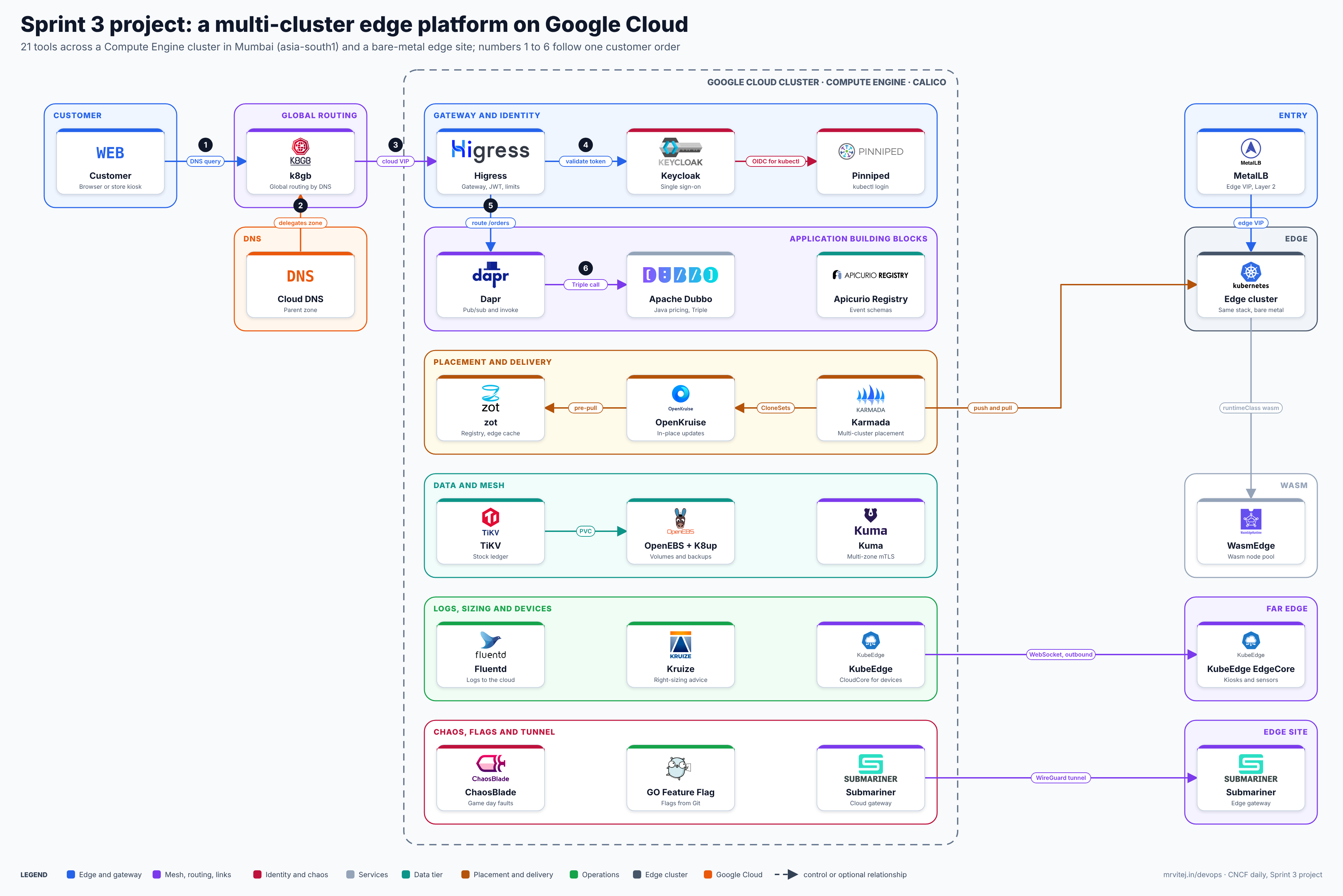
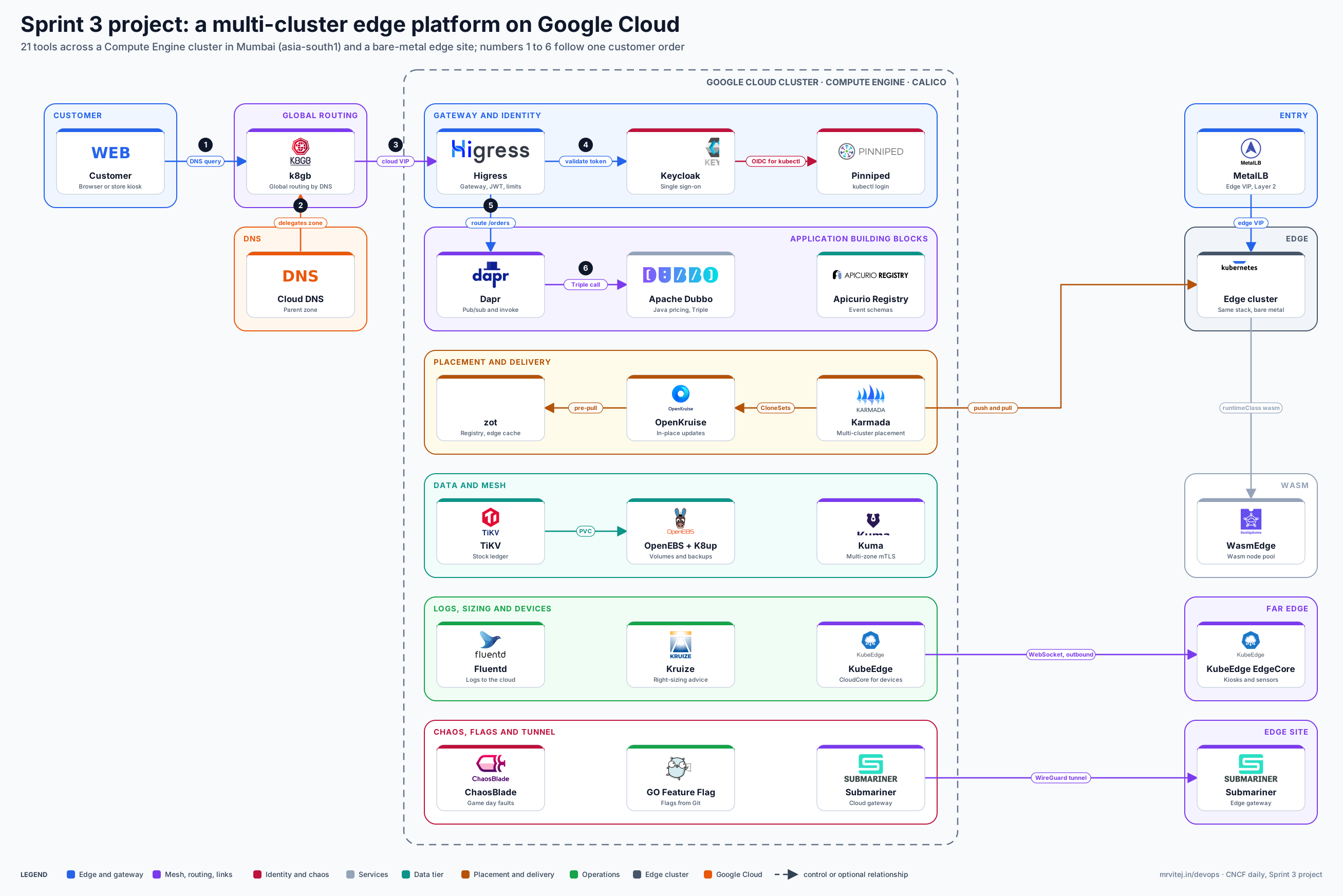
One image, every tool with its logo. The numbers 1 to 6 follow a customer order into the services. Open the zoomable diagram (scroll or pinch to zoom, drag to pan), or download it as SVG or PNG. The left side is the customer path, the dashed box is the Google Cloud cluster, and the right side is the edge site with its own copy of the stack. Only the cross-site links are drawn between them.
The platform is easier to read as three views of one system: the request and data path, the sites, connectivity and delivery, and operations and data protection. Every tool appears in at least one view, and each arrow is labelled with what travels over it.
View 1: request and data path
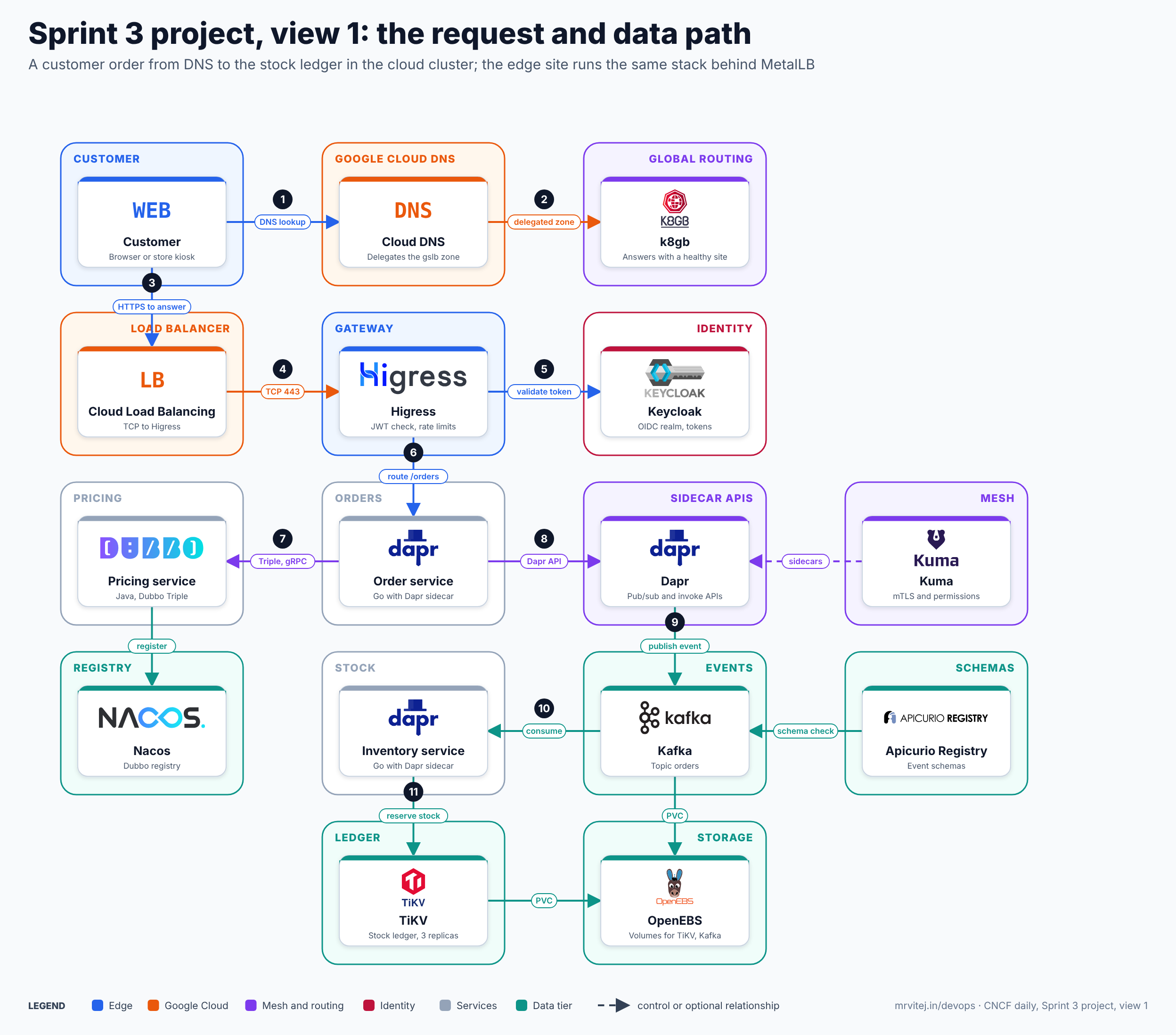
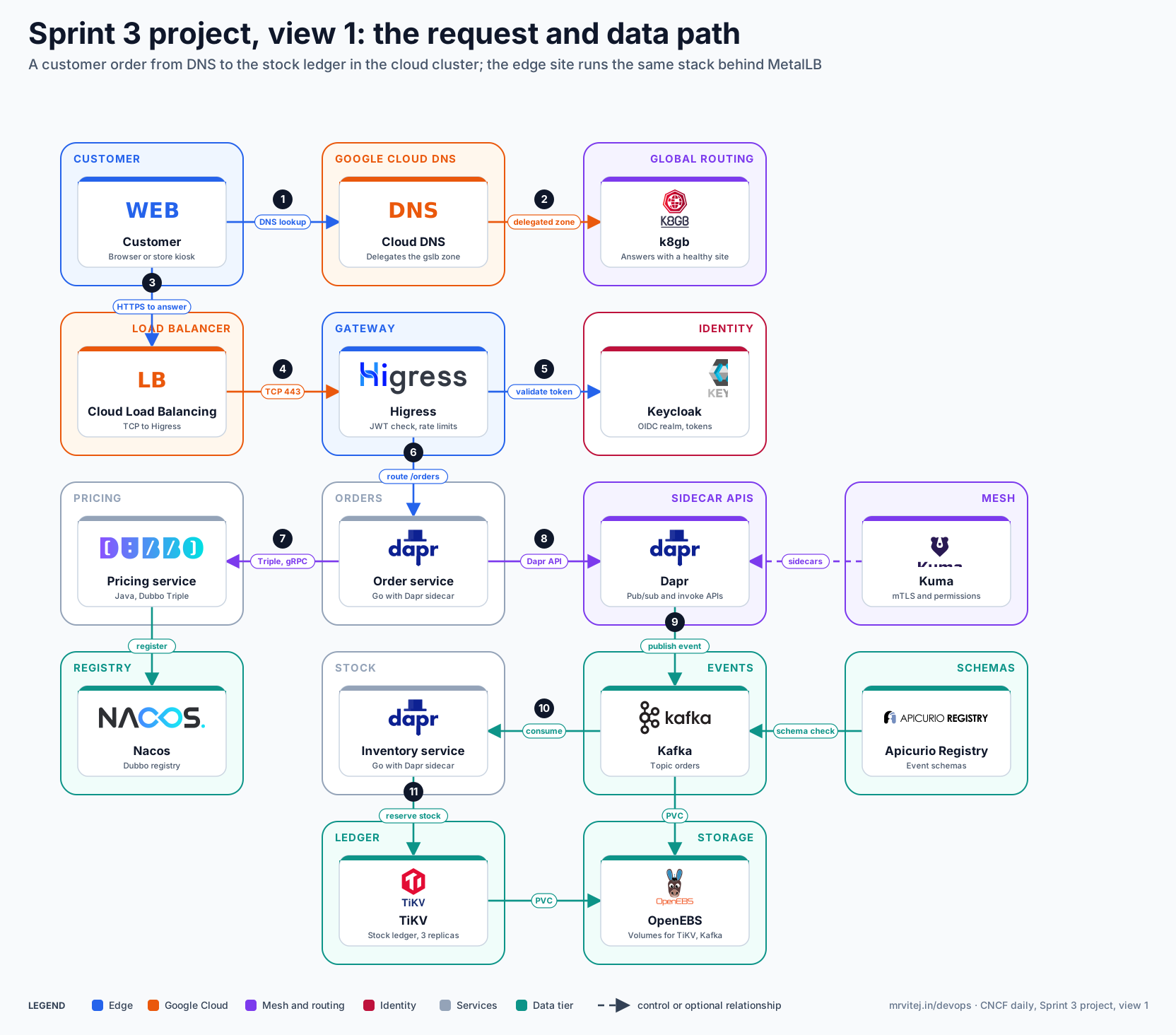
Blue is the edge, orange Google Cloud, purple mesh and routing, red identity, grey the services and teal the data tier. The edge site runs the same stack behind MetalLB instead of Cloud Load Balancing. Open the zoomable diagram, or download it as SVG or PNG.
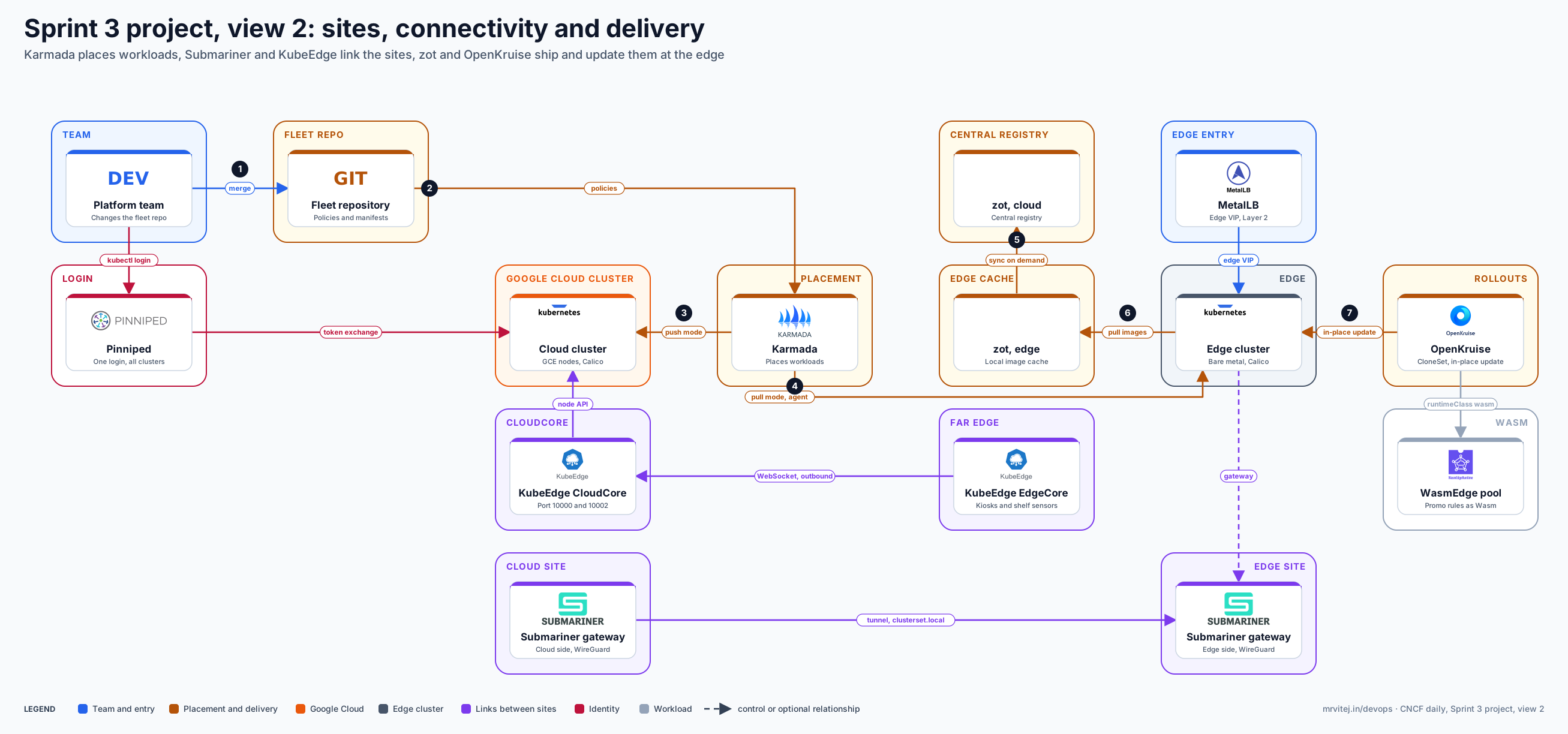
View 2: sites, connectivity and delivery
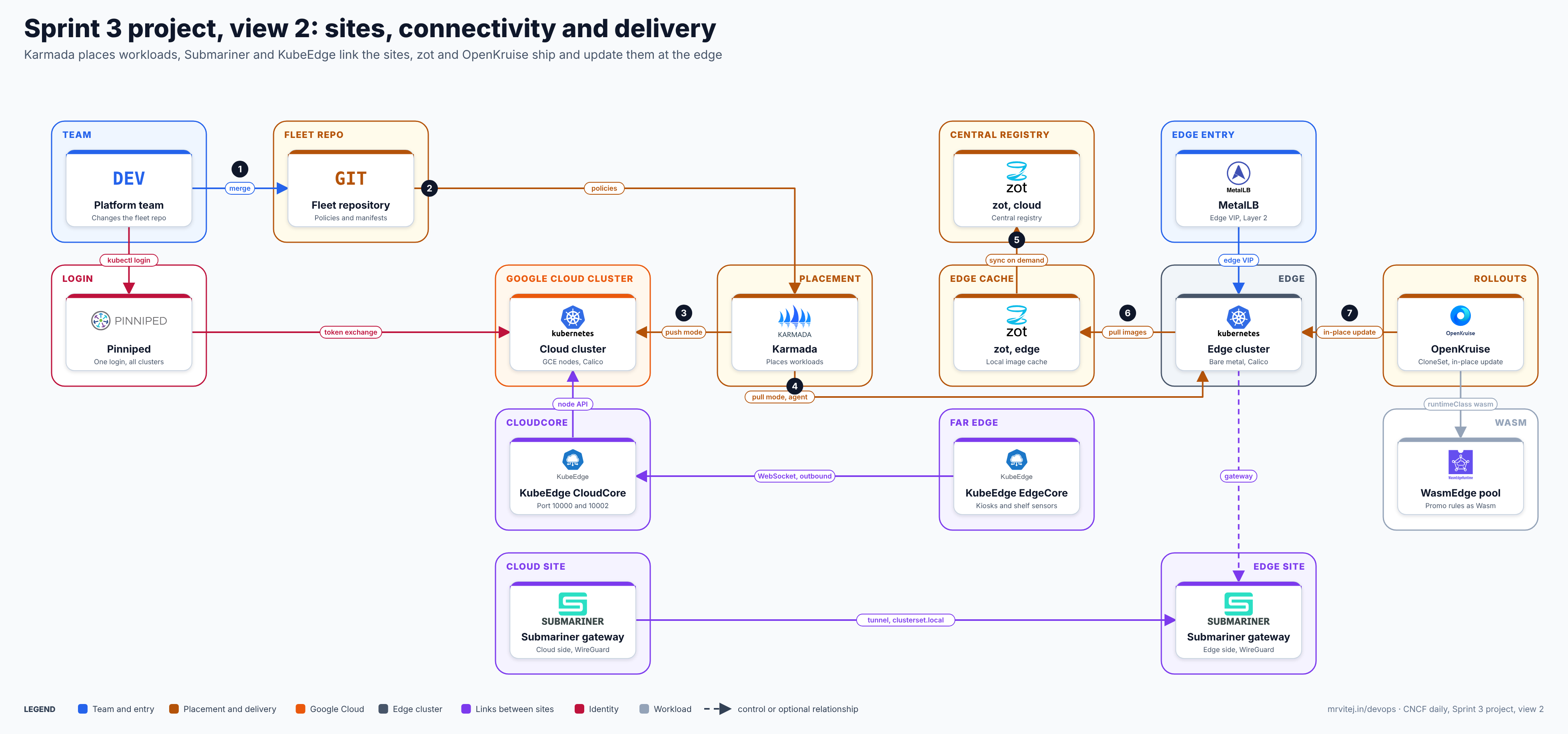
Amber is placement and delivery, purple the links between sites, red identity. The numbers 1 to 7 follow a change from a merged pull request to a running pod at the edge. Pinniped’s Concierge runs in each cluster; one arrow stands for all of them. Open the zoomable diagram, or download it as SVG or PNG.
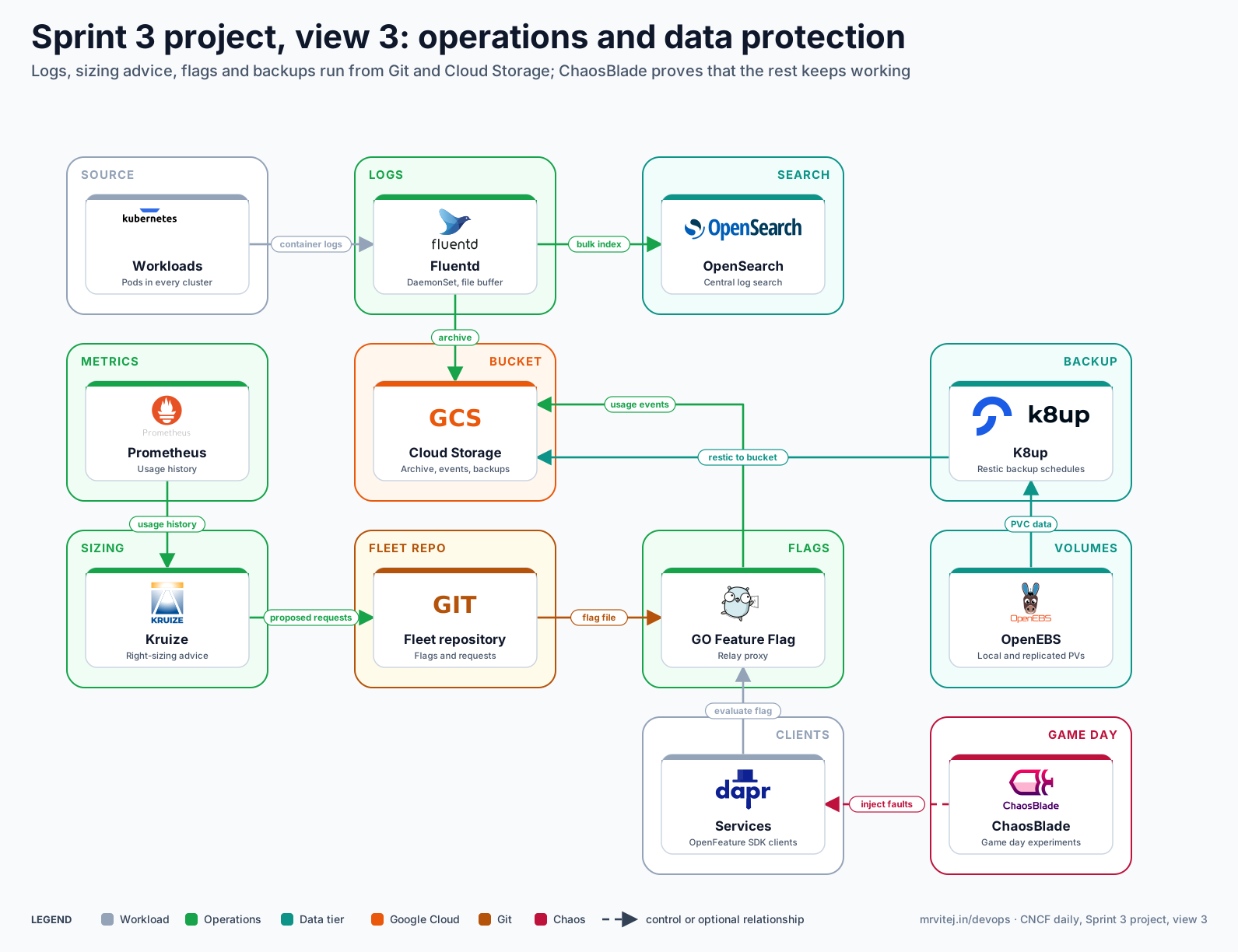
View 3: operations and data protection
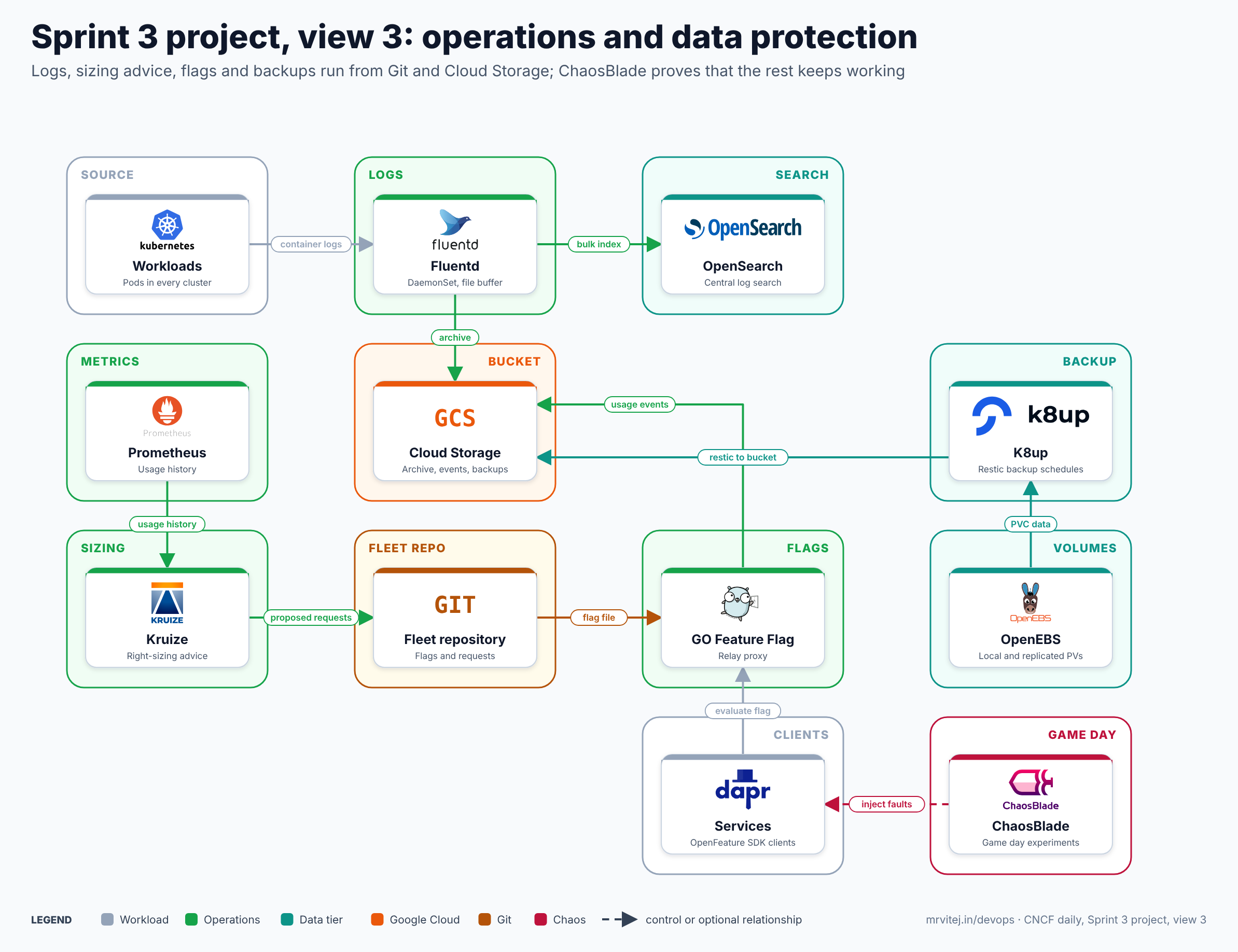
Green is operations, teal the data tier, red chaos. Logs, flag events and volume backups all land in Cloud Storage; the sizing advice and the flag file live in Git. Open the zoomable diagram, or download it as SVG or PNG.
Wiring reference
Every integration point in the three views, with what is configured at each one.
| From | To | Protocol and port | What is configured |
|---|---|---|---|
| Customer | Cloud DNS, k8gb | DNS, UDP and TCP 53 | A parent zone in Cloud DNS delegates gslb.example.com to each cluster’s CoreDNS address, where k8gb answers with healthy addresses. |
| Cloud Load Balancing | Higress | TCP 443 | A passthrough network load balancer to the nodes’ Higress NodePort. At the edge, MetalLB gives the Higress service an address instead. |
| Higress | Keycloak | HTTPS | The JWT plugin uses the realm’s JWKS endpoint to validate tokens before routing. |
| Higress | Order service | HTTP | An Ingress with ingressClassName: higress, routes by path, rate limits per route. |
| Order service | Pricing service | gRPC, Triple, port 50051 | The Go service calls the Dubbo provider’s Triple port with a gRPC client. Nacos is the provider’s registry. |
| Services | Dapr | HTTP and gRPC on localhost 3500 and 50001 | The sidecar exposes publish and invoke APIs; components are defined per namespace. |
| Dapr | Kafka | Kafka protocol 9092 | pubsub.kafka component, CloudEvents JSON on topic orders. |
| CI | Apicurio Registry | HTTPS | Schemas are registered on merge with a BACKWARD compatibility rule; auto-registration is off in production. |
| Inventory service | TiKV | gRPC to PD 2379 | The transactional client with the PD endpoints; three PD and three TiKV pods on OpenEBS local volumes. |
| OpenEBS | K8up, Cloud Storage | PVC, HTTPS | K8up Schedule backs up the application namespaces to a bucket through the S3-compatible API. |
| Kuma sidecars | Kuma control plane | KDS, port 5685 | A global control plane in the cloud cluster and a zone control plane in each cluster, with mutual TLS and permissions. |
| Karmada | Member clusters | Kubernetes API, HTTPS | Push mode to the cloud cluster; pull mode (agent) at the edge, so the edge makes outbound connections only. |
| Karmada | OpenKruise | Kubernetes API | PropagationPolicy for CloneSet; the interpreter for it must exist in your Karmada version. |
| OpenKruise | Nodes | Kubelet and containerd | ImagePullJob pre-pulls from the local zot before each rollout. |
| Edge zot | Central zot | HTTPS 5000 | sync extension with onDemand, so the edge fetches an image once and serves it locally. |
| Submariner gateways | Each other | UDP 4500 and 4490, WireGuard | A broker in the cloud cluster, subctl join on both, non-overlapping CIDRs, firewall rules on both sides. |
| KubeEdge EdgeCore | CloudCore | WebSocket, TCP 10000, 10002 | Outbound only from the edge; the cloud address is a stable static IP. |
| MetalLB | Edge network | ARP or BGP | An IPAddressPool outside the DHCP range with an L2Advertisement. |
| Pinniped | Keycloak | OIDC | A Supervisor with a FederationDomain and an OIDCIdentityProvider; a Concierge and JWTAuthenticator in each cluster. |
| Fluentd (edge) | Fluentd (cloud) | Forward protocol, TCP 24224 with shared_key |
File buffer sized for the longest outage; the cloud aggregator writes to OpenSearch and Cloud Storage. |
| Kruize | Prometheus | HTTP | Metric and metadata profiles, one experiment per container. |
| GO Feature Flag | Git or ConfigMap | HTTPS or API | A retriever polls the flag file; usage events go to an exporter. |
| ChaosBlade | Nodes, pods | Kubernetes API | ChaosBlade resources, one per experiment, with narrow matchers. |
Build order
Each step depends on the one before it. Build and verify one layer at a time, cloud first, then the edge.
- Google Cloud foundation (GCP). Create the project, VPC, subnets, firewall rules, a service account with least privilege, a Cloud DNS zone and the Cloud Storage buckets.
- Cloud cluster. Build three or more Compute Engine VMs, run
kubeadm, install Calico and containerd, and join workers. Pick pod and service ranges that will not overlap with the edge. - Edge cluster. Build the bare-metal cluster with the same Kubernetes version and Calico, with its own non-overlapping ranges. Install MetalLB.
- Registries. Run zot in the cloud and at the edge, then point containerd at them.
- Links between sites. Deploy the Submariner broker and join both clusters. Install KubeEdge CloudCore in the cloud cluster.
- Placement. Install the Karmada control plane in its own small cluster or namespace and join the cloud cluster (push) and the edge cluster (pull).
- Identity. Install PostgreSQL, Keycloak and Pinniped (Supervisor in the cloud, Concierge in each cluster).
- Mesh and edge entry. Install Kuma (global control plane, then zones) and Higress; configure Cloud Load Balancing and k8gb.
- Storage and data. Install OpenEBS and K8up, then TiKV, Kafka and Apicurio Registry.
- Applications. Install Dapr, Nacos, then the pricing, order and inventory services as OpenKruise CloneSets propagated by Karmada.
- Operations. Install Fluentd, Kruize and the GO Feature Flag relay proxy.
- Edge extras. Join a KubeEdge device node and add a WasmEdge node pool.
- Break it. Run the ChaosBlade game day below.
Build guide: Google Cloud, Mumbai (asia-south1)
GCP. Terraform with the Google provider describes the foundation. This sketch shows the shape; review the provider documentation and pin versions before applying:
provider "google" {
  project = var.project_id
  region  = "asia-south1"
}

resource "google_compute_network" "platform" {
  name                    = "sprint3"
  auto_create_subnetworks = false
}

resource "google_compute_subnetwork" "nodes" {
  name          = "sprint3-nodes"
  network       = google_compute_network.platform.id
  region        = "asia-south1"
  ip_cidr_range = "10.0.0.0/24"
}

# Submariner gateways and KubeEdge CloudCore, from the edge site's public address
resource "google_compute_firewall" "cross_site" {
  name    = "sprint3-cross-site"
  network = google_compute_network.platform.name
  allow {
    protocol = "udp"
    ports    = ["4500", "4490"]
  }
  allow {
    protocol = "tcp"
    ports    = ["10000", "10002", "5685"]
  }
  source_ranges = [var.edge_public_cidr]
}

resource "google_compute_instance" "cp" {
  name           = "cloud-cp-1"
  machine_type   = "e2-standard-4"
  zone           = "asia-south1-a"
  can_ip_forward = true   # gateway nodes forward packets for pod networks
  boot_disk { initialize_params { image = "ubuntu-os-cloud/ubuntu-2204-lts" size = 80 } }
  network_interface {
    subnetwork = google_compute_subnetwork.nodes.id
    access_config {}
  }
}

resource "google_storage_bucket" "backups" {
  name          = "${var.project_id}-sprint3-backups"
  location      = "ASIA-SOUTH1"
  force_destroy = false
}

resource "google_dns_managed_zone" "parent" {
  name     = "example-com"
  dns_name = "example.com."
}
Then initialise Kubernetes with ranges that will not overlap the edge cluster, and install Calico:
# cloud cluster
kubeadm init --pod-network-cidr=10.10.0.0/16 --service-cidr=10.11.0.0/16 \
  --control-plane-endpoint=<cloud-api-address>:6443
# edge cluster uses 10.20.0.0/16 and 10.21.0.0/16
Three Google Cloud details need care on self-managed clusters:
- Load balancers.
kubeadmdoes not install a cloud controller manager, so aServiceof typeLoadBalancerwill not create a Google load balancer by itself. Either install the Google cloud controller manager, or run Higress behind a NodePort and create an external passthrough Network Load Balancer yourself that points at the nodes and checks the health of that port. - Identity for pods. GKE’s Workload Identity is a GKE feature. On self-managed nodes, give each tool a dedicated service account with only the roles it needs and store its key as a Secret, or use Workload Identity Federation with the cluster’s OIDC issuer if your policy forbids long-lived keys. K8up uses HMAC keys for the S3-compatible interface.
- k8gb and Cloud DNS. Follow the k8gb Google Cloud guide: ExternalDNS manages the delegation records in the parent zone, each cluster has its own
txtOwnerIdandtxtPrefix, and UDP 53 must reach each cluster’s CoreDNS load balancer. Leftover records may need to be deleted by hand at cleanup.
Check: kubectl get nodes shows the cloud nodes Ready, a test Service is reachable through the load balancer, and gcloud storage ls lists the bucket.
Key integration config
The snippets below are the points where tools meet. Resource versions change between releases, so check the API versions in each tool’s documentation for the release you install.
Karmada: place the order service on both clusters, weighted towards the cloud.
apiVersion: policy.karmada.io/v1alpha1
kind: PropagationPolicy
metadata: { name: order, namespace: shop }
spec:
  resourceSelectors:
    - { apiVersion: apps.kruise.io/v1alpha1, kind: CloneSet, name: order }
  placement:
    clusterAffinity:
      clusterNames: [cloud-gcp, edge-vizag]
    replicaScheduling:
      replicaSchedulingType: Divided
      replicaDivisionPreference: Weighted
      weightPreference:
        staticWeightList:
          - { targetCluster: { clusterNames: [cloud-gcp] }, weight: 2 }
          - { targetCluster: { clusterNames: [edge-vizag] }, weight: 1 }
Karmada needs a resource interpreter to divide replicas of a custom workload type such as a CloneSet. Check that your release ships one for OpenKruise, or add your own, before you depend on this.
OpenKruise: an in-place canary with the image pre-pulled from the edge registry.
apiVersion: apps.kruise.io/v1alpha1
kind: CloneSet
metadata: { name: order, namespace: shop }
spec:
  replicas: 6
  selector: { matchLabels: { app: order } }
  template:
    metadata:
      labels: { app: order }
      annotations: { dapr.io/enabled: "true", dapr.io/app-id: "order", dapr.io/app-port: "8080" }
    spec:
      containers:
        - name: order
          image: registry.edge.local/shop/order:1.4.0
  updateStrategy:
    type: InPlaceIfPossible
    partition: 5
    maxUnavailable: 20%
Submariner: join, then export the pricing service across sites.
subctl deploy-broker --kubeconfig cloud.kubeconfig
subctl join broker-info.subm --kubeconfig cloud.kubeconfig --clusterid cloud-gcp --cable-driver wireguard
subctl join broker-info.subm --kubeconfig edge.kubeconfig  --clusterid edge-vizag --cable-driver wireguard
subctl export service --namespace shop pricing
# callable from the other cluster as pricing.shop.svc.clusterset.local
Dapr: pub/sub on the Kafka orders topic.
apiVersion: dapr.io/v1alpha1
kind: Component
metadata: { name: orderpubsub, namespace: shop }
spec:
  type: pubsub.kafka
  version: v1
  metadata:
    - { name: brokers, value: "shop-kafka-bootstrap.data:9092" }
    - { name: authType, value: "none" }
Kuma: only the order service may call inventory.
apiVersion: kuma.io/v1alpha1
kind: MeshTrafficPermission
metadata:
  name: orders-to-inventory
  namespace: kuma-system
  labels: { kuma.io/mesh: default }
spec:
  targetRef: { kind: MeshSubset, tags: { kuma.io/service: inventory_shop_svc_8080 } }
  from:
    - targetRef: { kind: MeshSubset, tags: { kuma.io/service: order_shop_svc_8080 } }
      default: { action: Allow }
Pinniped: log in to every cluster through Keycloak. The Supervisor lives in the cloud cluster; each cluster has a Concierge with its own audience.
apiVersion: config.supervisor.pinniped.dev/v1alpha1
kind: FederationDomain
metadata: { name: platform, namespace: pinniped-supervisor }
spec:
  issuer: https://login.example.com/platform
  tls: { secretName: supervisor-tls }
---
apiVersion: authentication.concierge.pinniped.dev/v1alpha1
kind: JWTAuthenticator
metadata: { name: platform-supervisor }
spec:
  issuer: https://login.example.com/platform
  audience: edge-vizag-<unique-random-value>
The Supervisor also needs an OIDCIdentityProvider that points at the Keycloak realm and is listed under the FederationDomain; check its fields against the Pinniped documentation for your version.
zot at the edge: serve locally, fetch from the cloud once.
"sync": { "registries": [ { "urls": ["https://registry.example.com"], "onDemand": true, "tlsVerify": true } ] }MetalLB at the edge: a pool outside the DHCP range.
apiVersion: metallb.io/v1beta1
kind: IPAddressPool
metadata: { name: edge-pool, namespace: metallb-system }
spec: { addresses: ["192.168.10.240-192.168.10.250"] }
---
apiVersion: metallb.io/v1beta1
kind: L2Advertisement
metadata: { name: edge-l2, namespace: metallb-system }
spec: { ipAddressPools: ["edge-pool"] }
k8gb: prefer the edge for local customers, fail over to the cloud.
apiVersion: k8gb.io/v1beta1
kind: Gslb
metadata: { name: shop, namespace: shop }
spec:
  resourceRef:
    apiVersion: networking.k8s.io/v1
    kind: Ingress
    matchLabels: { app: shop }
  strategy:
    type: failover
    primaryGeoTag: edge-vizag
KubeEdge: join a kiosk machine as an edge node.
keadm init --advertise-address="<CLOUDCORE-ADDRESS>" --kubeedge-version=v1.23.1 --kube-config=/root/.kube/config
keadm gettoken
keadm join --cloudcore-ipport="<CLOUDCORE-ADDRESS>":10000 --token=<TOKEN> --kubeedge-version=v1.23.1
K8up: nightly backups of the shop namespaces to Cloud Storage.
apiVersion: k8up.io/v1
kind: Schedule
metadata: { name: shop, namespace: shop }
spec:
  backend:
    s3:
      endpoint: https://storage.googleapis.com
      bucket: <project>-sprint3-backups
      accessKeyIDSecretRef: { name: backup-keys, key: access-key }
      secretAccessKeySecretRef: { name: backup-keys, key: secret-key }
    repoPasswordSecretRef: { name: backup-repo, key: password }
  backup: { schedule: '0 2 * * *' }
  check: { schedule: '0 1 * * 1' }
  prune: { schedule: '0 1 * * 0', retention: { keepLast: 5, keepDaily: 14 } }
Fluentd at the edge: buffer to disk, forward to the cloud aggregator.
<match kubernetes.**>
  @type forward
  <server>
    host fluentd.cloud.example.internal
    port 24224
  </server>
  <security>
    self_hostname edge-vizag
    shared_key <secret>
  </security>
  <buffer>
    @type file
    path /var/log/fluentd-buffers/forward
    total_limit_size 4GB
    retry_max_interval 60s
    overflow_action block
  </buffer>
</match>
GO Feature Flag: a flag file in a ConfigMap, a 20% rollout of new pricing.
new-pricing:
  variations: { on: true, off: false }
  targeting:
    - query: email co "@example.com"
      percentage: { on: 100, off: 0 }
  defaultRule:
    percentage: { on: 20, off: 80 }
Kruize: one experiment per container, then read the advice.
POST /createMetricProfile
POST /dsmetadata
POST /createExperiment
POST /generateRecommendations?experiment_name=order
GET  /listRecommendations?experiment_name=order
The other tools are configured as in their briefs: TiKV with the TiDB Operator, Dubbo with Nacos and the Triple protocol, WasmEdge with a RuntimeClass named wasm, Keycloak with its operator, Higress with an Ingress class, and Apicurio Registry with a BACKWARD compatibility rule.
Request walk-through
- The customer opens
https://shop.example.com. Cloud DNS delegates thegslbzone to the clusters, and k8gb answers with the address of a healthy site, normally the nearest store. - The request reaches Cloud Load Balancing (or MetalLB at the edge) and then Higress, which checks the customer’s Keycloak token and applies rate limits.
- Higress routes
/ordersto the order service. Kuma’s sidecars encrypt the hop, and a permission allows only this path. - The order service calls the pricing service over Triple. The result depends on the
new-pricingflag served by the GO Feature Flag relay proxy. - The order service publishes an
order.createdevent through Dapr to Kafka. The schema was checked in CI by Apicurio Registry. - The inventory service consumes the event and reserves stock in TiKV inside a transaction. If the edge site has lost its link to the cloud, orders still complete locally, and events are replicated when the link returns.
- Fluentd ships the logs of every hop to the cloud aggregator and OpenSearch.
Deployment walk-through
- A developer merges a change to the fleet repository: a new image tag for the order service and an updated flag file.
- Karmada sees the changed
CloneSetand propagates it: directly to the cloud cluster, and through its pull-mode agent to the edge cluster. - At the edge, an
ImagePullJobasks containerd to pre-pull the image from the local zot. On a miss, zot fetches it once from the central registry. - OpenKruise updates the pods in place, starting with the canary partition, so the containers restart without rescheduling the pods.
- The new version starts behind a feature flag. The flag file is enabled for staff first and then raised from 20% in steps.
- Kruize reads the new usage and, after enough history, proposes smaller or larger requests as a pull request.
- If signals worsen, the flag is switched off first and a Git revert makes Karmada roll the cluster back.
Incident walk-through
Scenario: the Vizag store’s link to the cloud drops during a sale, and orders there are slow.
- An alert fires on the Submariner connection status, and k8gb health checks begin to fail for the cloud cluster from the edge’s point of view.
- Customers at the store still reach the edge Higress through MetalLB, since k8gb prefers the local site. Orders continue, and TiKV at the edge keeps its local ledger.
- Fluentd’s buffer on the edge nodes grows, because the forward to the cloud is failing. The team checks the buffer queue and disk use against the planned outage window.
- KubeEdge nodes stay up: devices keep running their pods without the cloud, and reconnect when the link returns.
- Once the link is back, Submariner reconnects, the buffered logs drain, and the order events replicate. The team checks lag before declaring recovery.
- In the review, the team adds a larger buffer and an alert at 70% of it, and writes a ChaosBlade experiment that reproduces the outage in staging.
Game day with ChaosBlade
The goal is to prove that stores keep selling when a site is cut off from the cloud. Run in staging first, with a written hypothesis: orders at the edge succeed throughout, the Fluentd buffer does not overflow in 30 minutes, and replication catches up within ten minutes of the link returning.
apiVersion: chaosblade.io/v1alpha1
kind: ChaosBlade
metadata: { name: cpu-load-edge-node-1 }
spec:
  experiments:
  - scope: node
    target: cpu
    action: fullload
    desc: "CPU load on one edge node"
    matchers:
    - { name: names, value: ["edge-node-1"] }
    - { name: cpu-percent, value: ["60"] }
Cut the link itself by blocking the Submariner and KubeEdge ports on the edge firewall for 30 minutes (a manual step, since it is outside the cluster), and use ChaosBlade’s network experiments to add delay and loss on a node’s interface; check the project documentation for the parameters in your version. During each run, watch the order success rate in the dashboards and the buffer sizes. Follow with a node CPU load on the TiKV nodes and a pod kill of the Kuma control plane to confirm the data planes keep working. Write down what failed, fix it, and repeat before widening the blast radius.
Cost and cleanup
- Largest costs (GCP). The Compute Engine VMs (control plane and workers for the cloud cluster, plus Karmada’s), persistent disks for TiKV and Kafka, load balancer forwarding rules, Cloud NAT and egress between regions. Edge hardware is a fixed cost outside Google Cloud.
- Control with the platform itself. Kruize recommendations right-size requests so fewer nodes are needed, K8up prunes old backups, and Cloud Storage lifecycle rules expire archived logs.
- Teardown. Remove the Karmada propagation policies first so workloads are removed from the member clusters. Delete the k8gb
Gslbobjects and then any leftover records in Cloud DNS, remove the load balancer, empty the buckets, then destroy the VMs, network and firewall rules with the same Terraform you used to create them. Check for forwarding rules, reserved addresses and disks that remain. - Cheaper variant. For a learning setup, use one small cloud cluster and a single-node edge, one TiKV replica, skip KubeEdge and WasmEdge, and keep one registry. The wiring is unchanged.
AWS and Azure equivalents
| Need | Google Cloud | AWS | Azure |
|---|---|---|---|
| Virtual machines | Compute Engine | EC2 | Virtual Machines |
| Kubernetes | kubeadm on Compute Engine | kubeadm on EC2 (or EKS, with care for Submariner) | kubeadm on VMs (AKS has no Submariner guide) |
| DNS | Cloud DNS | Route 53 | Azure DNS |
| Load balancer | External passthrough Network Load Balancer | Network Load Balancer | Azure Load Balancer |
| Object storage | Cloud Storage (HMAC, S3 API) | S3 | Blob Storage |
| Firewall | VPC firewall rules | Security groups | Network security groups |
| Cloud identity for tools | Service account, Workload Identity Federation | IAM roles, IRSA on EKS | Managed identity, Workload Identity |
| k8gb DNS provider | Cloud DNS with ExternalDNS | Route 53 | Azure DNS |
Two points change by cloud. The Kubernetes layers (Karmada, Kuma, Dapr, TiKV, Kafka, OpenKruise and the rest) are identical, because they are Kubernetes resources. The provider steps (network, DNS, bucket access, load balancer and identity) differ, as do the firewall rules for Submariner and KubeEdge.
What to take from the sprint
- Decide what each overlapping tool is for. Karmada places clusters and KubeEdge attaches devices; Submariner links networks and Kuma secures calls; Dapr gives event APIs and Dubbo serves one Java service.
- Make the edge outbound-only. Karmada’s pull mode, KubeEdge’s WebSocket and Fluentd’s buffer all assume the edge calls the cloud, never the reverse, which keeps store firewalls simple.
- Treat the link as a failure mode. Local registries, local ledgers, buffered logs and flags in files mean a site keeps selling when the cloud is out of reach.
- Keep configuration in Git. Flags, placement policies, sizing advice and image tags all move through pull requests, so one history explains every change.
- Test the cut. A game day that really breaks the link tells you more than a diagram does.
Sprint 3 briefs: Dapr · OpenKruise · TiKV · Apicurio Registry · Karmada · Kuma · Higress · k8gb · MetalLB · Apache Dubbo · OpenEBS and K8up · Submariner · WasmEdge · Keycloak · zot · KubeEdge · Pinniped · Fluentd · ChaosBlade · Kruize · GO Feature Flag